
The couple's first retrospective, "Can Love Be a Photograph," explores their sprawling photography practice.
Dutch duo Inez & Vinoodh have photographed legends from Michael Douglas and Björk to Taylor Swift and Zendaya for glossy magazines, fashion houses, and more. “Can Love Be a Photograph,” the couple’s new retrospective—or “futurespective,” as they like to call it—at Kunstmuseum Den Haag presents many such portraits alongside their fashion photography and fine art shots, blurring the boundaries between them. The artists’ conceptual interest in challenging boundaries unites their varied modalities, in fact.
When I asked the photographers to spotlight six of the 150 works on view that best encapsulate their career, not one celebrity appeared. I asked why. “The way we approach every single picture is so similar,” Inez Van Lamsweerde told me of their portraiture practice over a video call. “For us, everyone is equal,” Vinoodh Matadin, seated next to her, added.
Most of the photographs Inez & Vinoodh chose hail from their fine art endeavors. Some have featured in print. One is their exhibition’s titular work—an ode to the love that’s powered their lives since they started working together in 1986. This kind of love transforms individuals into collectives and helps the photographers tap into their sitters’ souls. It’s the same love Simon Weils referenced when she said “attention is the rarest form of generosity”—a love that hopefully the world hasn’t totally forgotten.
Here are 6 highlights from the photographer’s oeuvre, handpicked by Inez & Vinoodh.
Thank You Thighmaster – Joan (1993)
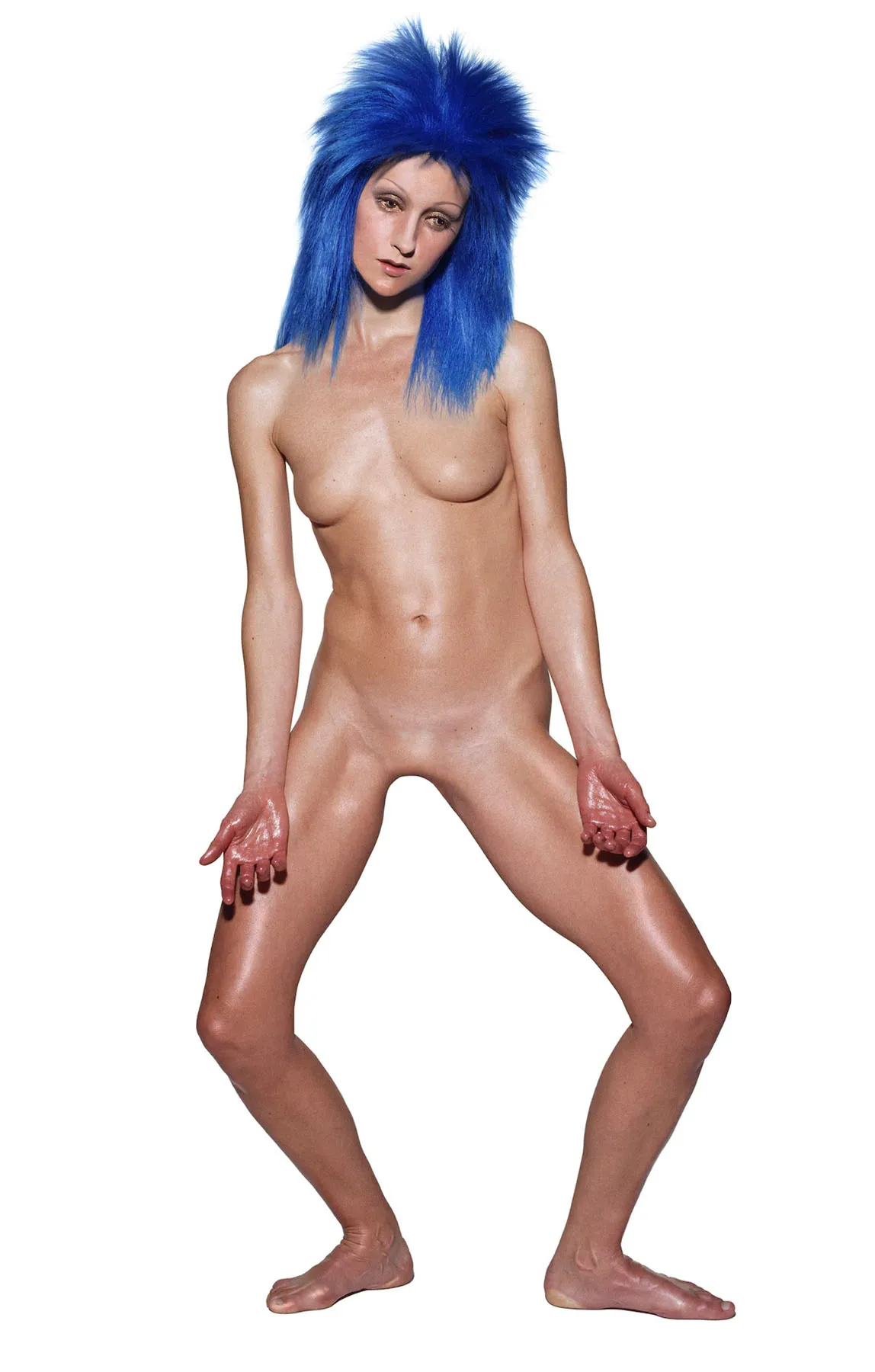
Thank You Thighmaster – Joan, 1993 © Inez & Vinoodh / courtesy The Ravestijn Gallery
Inez & Vinoodh’s best-known technical advancement lies in pioneering digital manipulation. The “Thank You Thighmaster” series is their second-ever experiment with such technology, after a small project for a Dutch city in 1992.
Thighmaster arose from their time living in Manhattan’s West Village that year, when Vinoodh joined Inez on her MoMA PS1 residency. “We were there as artists, and basically watched a lot of television because it was the birth of the Internet,” Van Lamsweerde said, “and the start of CNN’s 24 hour news cycle, in which news became entertainment.”
Recurring commercials caught their attention. “A lot of them were about physical perfection,” Van Lamsweerde said, “your hair, or machines to train your body.” The Thighmaster was everywhere. The very year that the World Wide Web went public, Inez & Vinoodh started contemplating what’s trustworthy and what the corporeal’s worth in the internet age.
As such, Inez & Vinoodh grafted dead-eyed mannequin faces on their models, smoothing over their genitalia and nipples with the revolutionary Quantel Paintbox to create flesh and blood plastic beings that “speak about this interior state,” Van Lamsweerde said, “this psychological mutation of this person that had been striving for this perfect body, but is completely deprived of physical contact and ravaged by emotions.”
Well Basically Basuco is Coke Mixed with Kerosine (1994)
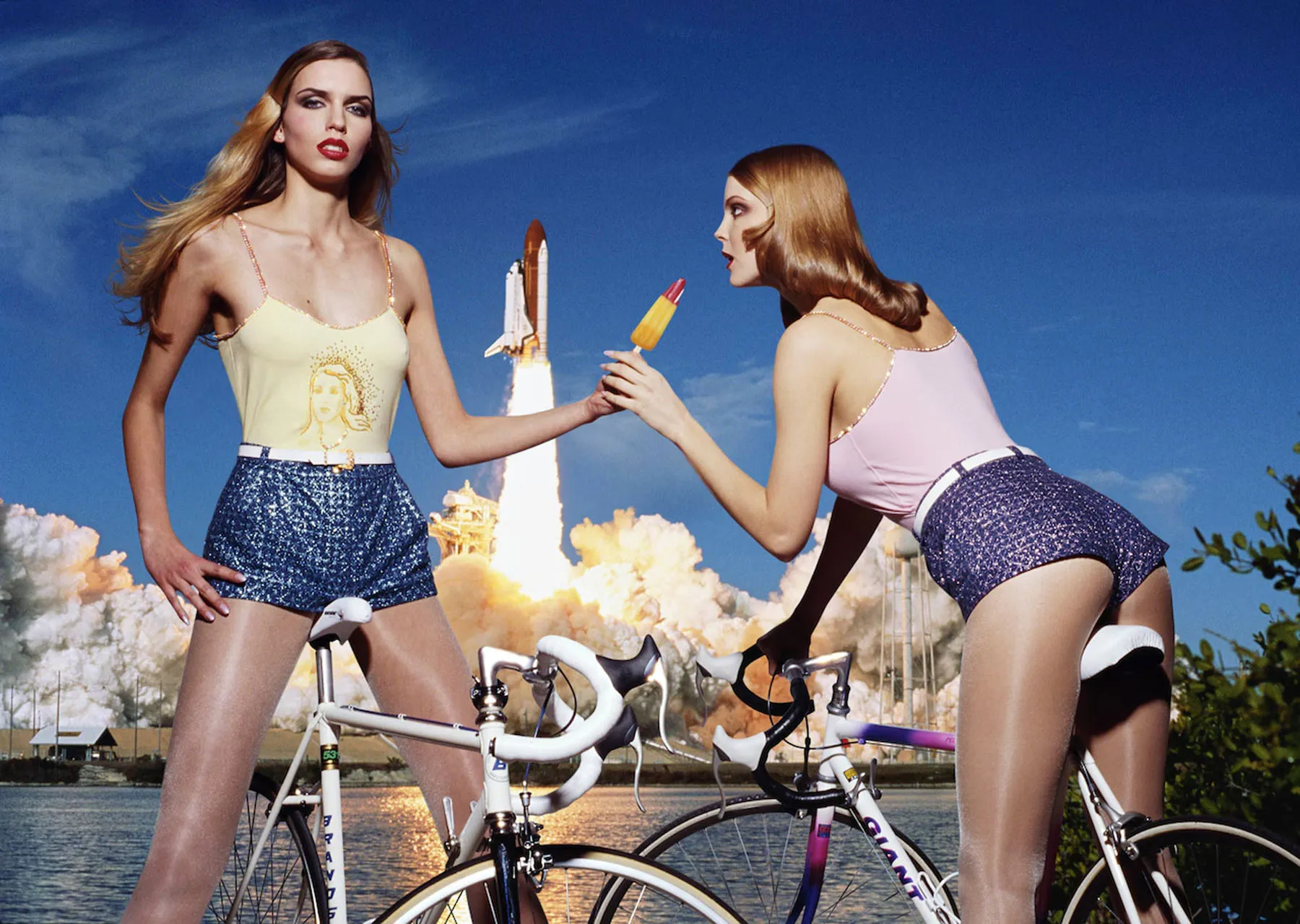
Well Basically Basuco is Coke Mixed with Kerosine… 1994 © Inez & Vinoodh / courtesy The Ravestijn Gallery
This explosive artwork hails from “For Your Pleasure,” the first series of photographs that The Face ever bought, rather than commissioned, from an artist. The six-image series yielded Inez & Vinoodh’s breakout moment. Their high-energy aesthetic became heir apparent to grunge’s cultural hold.
Each image here places models before stock scenes like an office and a cityscape, selected from image bank books. Inez & Vinoodh had noticed those tomes shared one fascinating trait with commercials: both artificially compartmentalized life into areas like business, travel, health, and sports, which are four of the five themes this series deals in. Basuco falls under the last one, science.
After nearly a decade in fashion, Inez & Vinoodh were tiring of the industry’s obsession with “candid” spreads. “Fashion is essentially staged photography,” Van Lamsweerde said. “Reality didn’t appeal to us.”
Basuco is the most provocative photograph that “For Your Pleasure” produced, replete with hot pants, pedal bikes, and two rockets—the firecracker popsicle one girl’s holding out for the other, and the life-sized spacecraft blasting off behind them. Inez & Vinoodh’s fashion photography subsequently took off, too.
ME #01 (1998)

ME #01 (featured in a Balenciaga ad) 1998 © Inez & Vinoodh / courtesy The Ravestijn Gallery
The similarly experimental “ME” series feels far more subdued than “For Your Pleasure.” Here, Inez & Vinoodh took inspiration from the web of interactions arising from every shoot—between the photographers, their subjects, and the viewer.
Every time Inez & Vinoodh photograph someone, they achieve their charged shots “by canceling out our own ego and being as open and giving as possible,” Van Lamsweerde said. “But as you’re doing that, inevitably, it becomes a self-portrait.”
They constructed a bed with its back pushed up “so that you get a strange forced perspective, where the eyes are on the height of the camera,” she continued. Inez & Vinoodh each eventually posed in the prop themselves. But, the series’s first sitter was Russian model Chloe Pechekhonova. The resulting Balenciaga advertisement marked the Spanish house’s overhaul under then-newly appointed creative director Nicolas Ghesquière. That’s another reason for the bed: “She’s coming back from the dead,” Matadin said.
Me Kissing Vinoodh (Passionately) (1998)
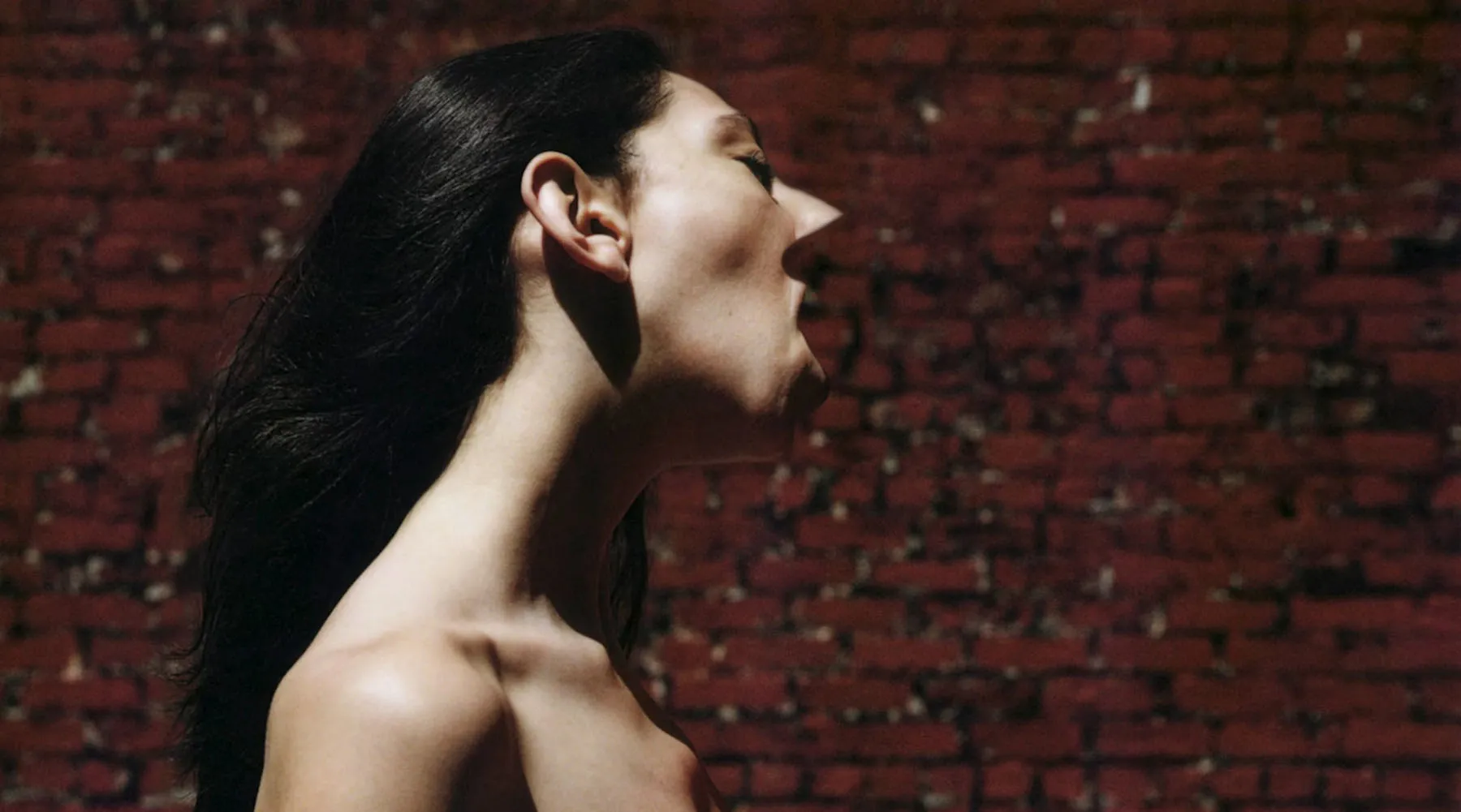
Me Kissing Vinoodh (Passionately) 1999 © Inez & Vinoodh / courtesy The Ravestijn Gallery
Inez & Vinoodh shared their first kiss at Paris Fashion Week in 1992. After six years of working together, they were finally both single. This ongoing series documents all the different ways they kiss, from Lovingly (1999) to Eternally (2010). Here, however, the couple digitally removed Vinoodh entirely. But, you can still see his silhouette cut out from Inez’s face, warping her elegant profile into something unsettling, transformed by grief.
This work is the first one that guests at Kunstmuseum den Haag encounter. Inez & VInoodh have printed the work large enough to take up a whole wall, like they did for their 2013 Gagosian show. “We felt this intimate moment actually needs to be on a cinematic scale,” Van Lamsweerde said. “It needs to have a macho component.” They originally shot the image on Polaroid 4×5 instant film, “which gives it that sort of melty, liquid feeling,” she added.
Think Love (2025)

Think Love, 2025 © Inez & Vinoodh / courtesy The Ravestijn Gallery
“Can Love Be a Photograph” also presents a new body of work that Inez & Vinoodh produced late last year using only Apple iPhones. These images depict their 22-year-old son Charles on a romantic Marfa adventure with his girlfriend and RISD classmate, Natalie.
Here, the young couple kisses in the foreground, the long road of life expanding out towards the desert horizon behind them. A sheer red veil envelopes the singular form they make—a clear metaphor for love’s protective membrane.
Inez & Vinoodh’s own ongoing “Kissing” series riffs off existing examples of the art historical trope by painters like Vienna Secessionist Gustav Klimt and Norwegian Symbolist Edvard Munch. Van Lamsweerde said they were pleased to create “The Kiss 3.0” with the rising generation. Instead of focusing “on their trauma, childhood, mother,” she said, today’s rising crop of artists are asking “where are we, who are we in this world, and what is needed for this world?”
To that end, this series subtly centers on perhaps the most important superstar in the entire show. “For us, nature is the celebrity of the future,” Matadin said.
Can Love be a Photograph (2025)

Can Love be a Photograph, 2025 @ Inez & Vinoodh / courtesy The Ravestijn Gallery
The titular photograph in the Inez & Vinoodh Hague retrospective marks a full circle moment. Here, Charles, captured from the ground up so as to look gargantuan, crouches over a cloche containing a photo of his parents kissing—Me and Vinoodh Kissing (Lovingly) (1999), to be specific.
“Here we are under this cloche,” Van Lamsweerde said, “But it’s our legacy also, our body of work and our family that Charles is bending over, protecting it in a way, but also beckoning the viewer to step through the portal.”
She also noted this series marks one rare gallery in the show lacking any digital manipulation—save for a tiny ladybug added for good luck, if you can spot it.
“Can Love Be a Photograph” is on view at Kunstmuseum Den Haag, Stadhouderslaan 41, The Hague, through September 6, 2026.
